CAUSE
Hemifacial Spasm

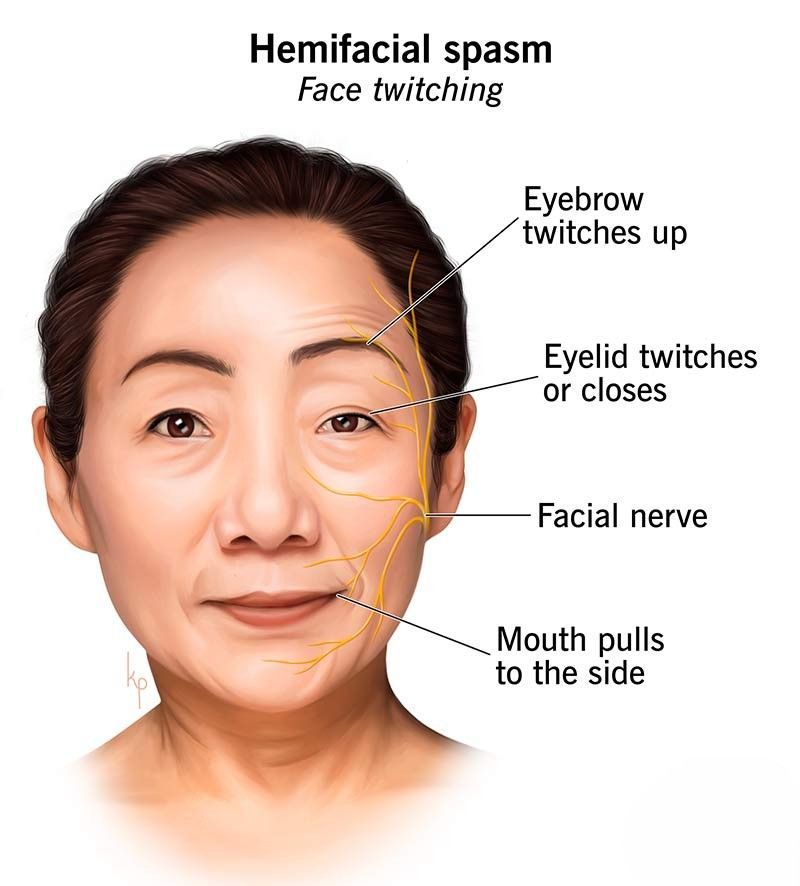
Hemifacial spasm is characterized by continuous involuntary twitching or contraction of muscles on one side of the face, which usually begins around the eye and spreads to the cheek and mouth. This condition is painless and cannot usually be controlled by any oral medications.
Hemifacial spasm can be caused by injury to the facial nerve, a tumor, or a blood vessel compressing the nerve. The most common cause is compression of the facial nerve by the anterior inferior cerebellar artery at the point where it emanates from the brain stem. The compression causes the nerve to misfire making your facial muscles contract or twitch. This condition is also related to trigeminal neuralgia —a condition arising from the fifth cranial nerve that causes severe facial pain.
Symptoms
Symptoms of hemifacial spasm include involuntary or irregular muscle contraction of one side of the face, starting from the eye moving down to the cheek and mouth.
Diagnosis
Your Orange County neurosurgeon, Dr. Robert Louis will carefully review your medical history and perform a neurological exam. A FIESTA MRI scan may be ordered to rule out other conditions such as a brain tumor, aneurysm, or AVM that may be causing facial nerve compression.
FIESTA (Fast Imaging Employing Steady-state Acquisition) MRI: is a special MRI setting that gives doctors a clear, detailed view of nerves and fluid-filled spaces, helping them spot small or subtle problems.
Treatment
An initial trial of oral medication may help to diminish the spasms. However, usually these are not effective. Botox may also be used as a temporizing measure to temporarily decrease the intensity or frequency of the spasms. The definitive treatment is surgical intervention to decompress the facial nerve and source of irritation. A minimally invasive keyhole approach for microvascular decompression (MVD) will allow your Orange County neurosurgeon Robert Louis, MD to move or separate the blood vessel and hold it away from the irritated nerve. MVD is performed using an microscopic retromastoid approach to create a small quarter-sized bony opening behind the ear.
Minimally Invasive Keyhole Approach
Robert Louis, MD performs this operation is performed through a quarter-sized bony opening using microscopic techniques. This keyhole approach preserves the surrounding normal structures as best as possible. By incorporating cutting-edge technology and instrumentation with proven surgical experience, we make surgery safer, less invasive, and more effective.
CONTACT US
Please feel free to fill out the form provided on the right with your questions and Dr. Louis and his team will get back to you as soon as possible.
Contact Us
We will get back to you as soon as possible.
Please try again later.